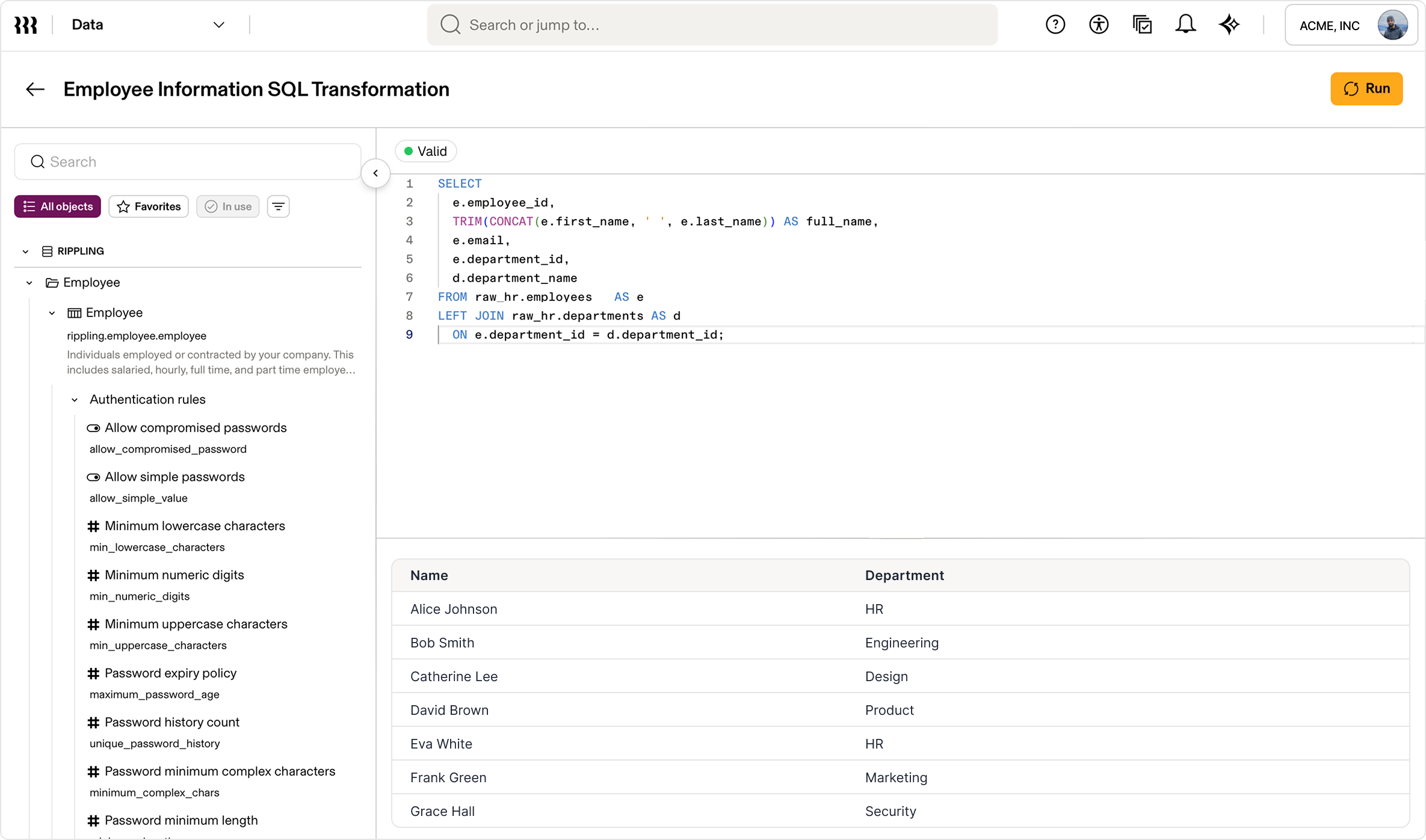
As Product Design Lead for Data Cloud, I led the end-to-end design of Transformations and Lineage from early strategy through launch. My scope included SQL authoring, AI-assisted creation, source discovery, validation, previews, refresh schedules, permissions, dependencies, and lineage.
Making business logic reusable
A metric can drift when its logic lives in a spreadsheet, dashboard formula, one-off query, or prompt. I designed Transformations to give that logic a governed home. Analysts could work directly in SQL to draft and refine a definition.
Transformations supported familiar SQL patterns and added Rippling-specific functions for organization hierarchies, historical context, and currency normalization. Each output became a reusable Data Cloud object with consistent permissions wherever it appeared.
From source data to shared definition
- Discover. Find the right source objects and fields, with their definitions and relationships in context.
- Define. Write or refine the SQL, inspect the output, and validate the logic before publishing it.
- Reuse. Publish a governed dataset for Reports, Dashboards, Rippling AI, Workflows, and Custom Apps.
Designing lineage
Reusable logic only works when teams can understand what depends on it. I designed Lineage alongside Transformations so people could trace a dataset from its sources to downstream reports, dashboards, and applications. Before changing the logic, they could understand the potential impact; when results looked wrong, they could follow the path upstream.
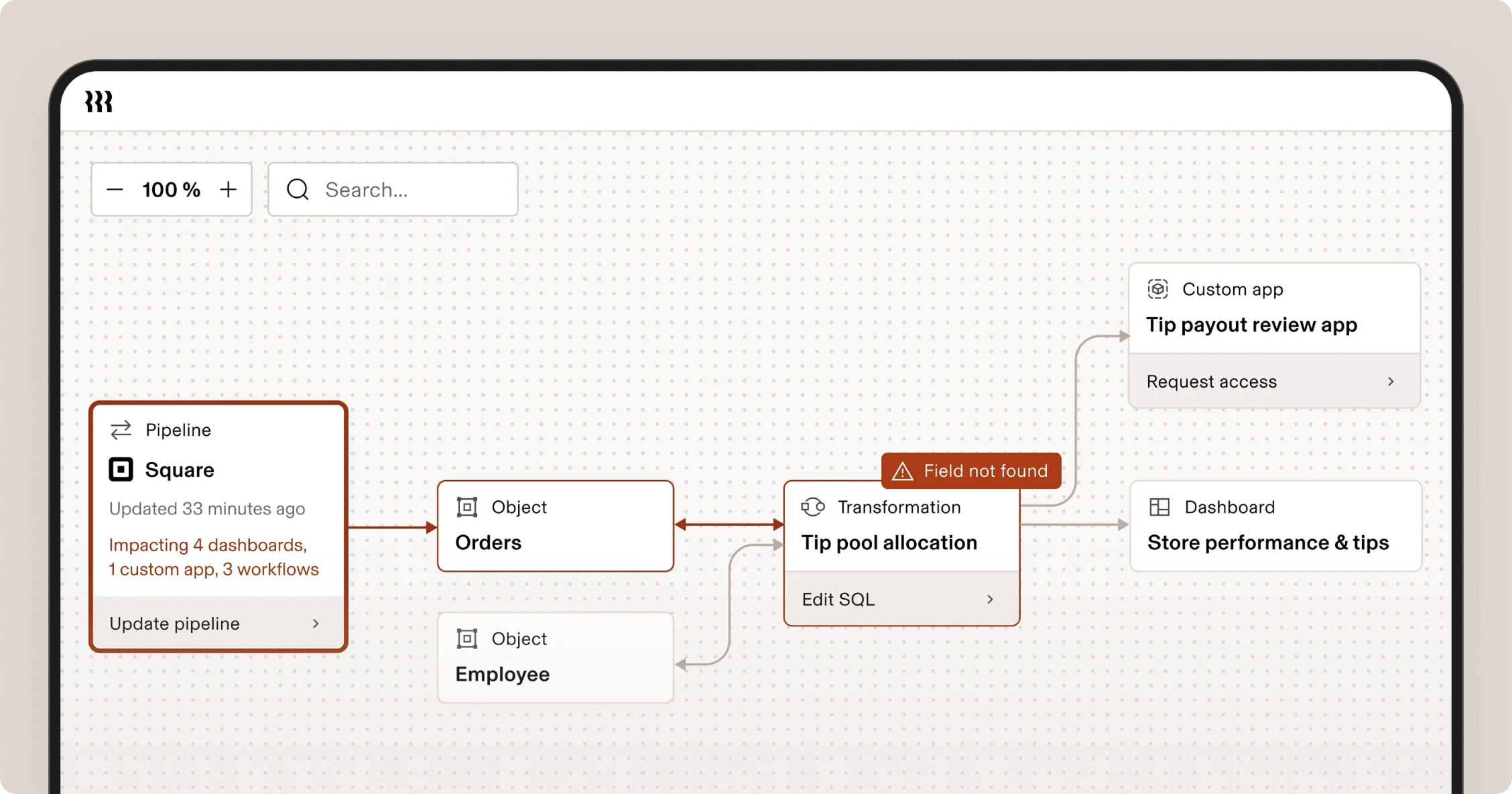
A foundation for consistent decisions
Transformations required more than a SQL editor. I created shared patterns for schema navigation, authoring, validation, scheduling, permissions, and lineage, connecting the technical work of defining data to the downstream experience of using it. The same governed datasets could support analysis, AI answers, and operational workflows across Rippling.